

Can a 3 DOF motion platform be used for aerospace purposes?
Sep 05, 2025
Can a 3 DOF Motion Platform be Used for Aerospace Purposes?
In the realm of aerospace engineering and research, the use of motion platforms has become an integral part of various applications. These platforms simulate different motion scenarios, allowing engineers, researchers, and pilots to test and train under realistic conditions. Among the different types of motion platforms, the 3 DOF (Degrees of Freedom) motion platform stands out as a versatile and cost - effective option. As a supplier of 3 DOF Motion Platforms, I have witnessed firsthand the potential and limitations of these platforms in aerospace applications.
Understanding 3 DOF Motion Platforms
A 3 DOF motion platform can move in three independent directions: pitch, roll, and yaw. Pitch refers to the up - and - down rotation of the platform, similar to the nose of an aircraft going up or down. Roll is the side - to - side rotation, like an aircraft banking to turn. Yaw is the rotation around the vertical axis, which is comparable to an aircraft changing its heading. This limited set of motions, compared to higher - DOF platforms, still offers a significant range of simulation possibilities.
The 3 DOF Motion Platform is designed with a combination of actuators, sensors, and control systems. Actuators are responsible for generating the motion, sensors measure the position and orientation of the platform, and the control system ensures that the platform moves according to the desired input. These components work together to create a realistic motion experience.
Aerospace Applications of 3 DOF Motion Platforms
Pilot Training
One of the primary aerospace applications of 3 DOF motion platforms is pilot training. For novice pilots, understanding the basic flight maneuvers such as takeoff, landing, and turning is crucial. A 3 DOF motion platform can simulate these maneuvers by providing the appropriate pitch, roll, and yaw motions. For example, during a takeoff simulation, the platform can pitch up to mimic the aircraft's nose rising, giving the pilot a sense of the acceleration and attitude change.
In addition, the platform can be used for instrument flight training. Pilots need to rely on their instruments to fly in poor visibility conditions. The 3 DOF motion platform can simulate the motion of an aircraft flying in such conditions, allowing pilots to practice using their instruments to maintain the correct attitude and heading.
Aerospace Research
In aerospace research, 3 DOF motion platforms are used for a variety of purposes. They can be used to test the performance of new aircraft control systems. By simulating different flight conditions on the platform, researchers can evaluate how the control system responds to changes in pitch, roll, and yaw. This helps in the development and improvement of more efficient and reliable control systems.
Another area of research is the study of human factors in aerospace. How pilots and astronauts respond to different motion stimuli is an important aspect of aerospace safety. The 3 DOF motion platform can be used to conduct experiments to understand how humans perceive and react to pitch, roll, and yaw motions. This information can be used to design better cockpit layouts and training programs.
Spacecraft Docking Simulations
Although spacecraft docking involves complex 6 - DOF motions, a 3 DOF motion platform can still play a role in the initial stages of training. It can simulate the relative pitch, roll, and yaw motions between two spacecraft during the approach phase. This allows astronauts to practice the basic alignment skills required for docking, providing a cost - effective alternative to full - scale 6 - DOF simulators.
Limitations of 3 DOF Motion Platforms in Aerospace
While 3 DOF motion platforms have many applications in aerospace, they also have some limitations. The most obvious limitation is the lack of translational motion (forward/backward, left/right, and up/down). In real - world aerospace scenarios, these translational motions are often present, especially during takeoff, landing, and high - speed maneuvers. Without the ability to simulate these motions, the training and research results may not be fully representative of actual flight conditions.
Another limitation is the limited range of motion. The pitch, roll, and yaw angles that a 3 DOF motion platform can achieve are often restricted compared to real aircraft or spacecraft. This can affect the accuracy of the simulation, especially for extreme flight maneuvers.
Comparison with High - End 6 DOF Motion Simulators
In contrast to 3 DOF motion platforms, High End 6 Dof Motion Simulator can provide a more comprehensive simulation experience. A 6 DOF simulator can move in all six degrees of freedom, including the three translational motions (surge, sway, and heave) in addition to pitch, roll, and yaw. This allows for a more realistic simulation of aerospace scenarios, such as high - speed flight, aerobatic maneuvers, and complex spacecraft docking operations.
However, high - end 6 DOF motion simulators are significantly more expensive to purchase and operate. They require more powerful actuators, larger control systems, and more space. For many small - scale aerospace training centers and research institutions, the cost of a 6 DOF simulator may be prohibitive. In such cases, a 3 DOF motion platform can be a more practical choice.
The Role of 3 Axis Motion Platforms
The 3 Axis Motion Platform is another option that is closely related to the 3 DOF motion platform. In some cases, the terms are used interchangeably, but there can be some differences. A 3 - axis motion platform may refer to a platform that can move along three linear axes (x, y, and z), while a 3 DOF motion platform focuses on rotational motions.

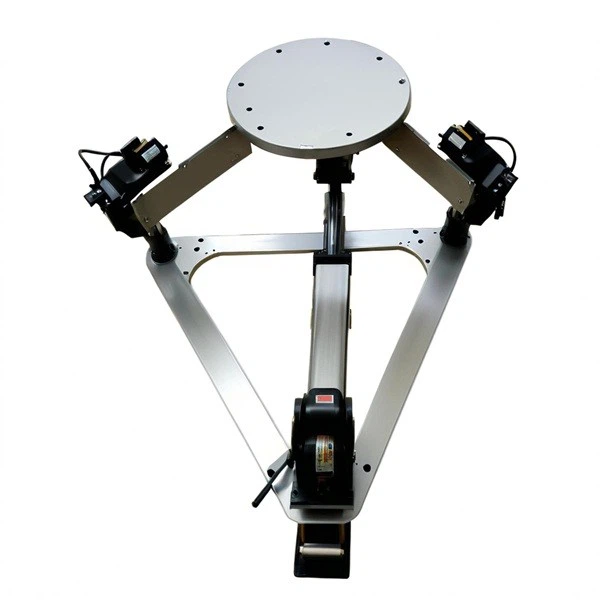
In aerospace applications, a 3 - axis motion platform can be used to simulate the translational motions that are lacking in a 3 DOF motion platform. For example, it can be used to simulate the acceleration and deceleration of an aircraft during takeoff and landing. By combining a 3 DOF motion platform with a 3 - axis motion platform, a more comprehensive aerospace simulation can be achieved.
Conclusion
In conclusion, a 3 DOF motion platform can indeed be used for aerospace purposes. It offers a cost - effective solution for pilot training, aerospace research, and some aspects of spacecraft docking simulations. While it has limitations compared to high - end 6 DOF motion simulators, its simplicity and affordability make it a viable option for many aerospace applications.
If you are interested in exploring the potential of a 3 DOF motion platform for your aerospace needs, I encourage you to contact us for a detailed discussion. We can provide you with more information about our products, customization options, and how they can be integrated into your existing aerospace training or research programs.
References
- Anderson, J. D. (2007). Introduction to Flight. McGraw - Hill.
- Roskam, J. (2003). Airplane Flight Dynamics and Automatic Flight Controls. DARcorporation.
- Shneyderman, B. (2004). Human - Computer Interaction Design Strategies. Addison - Wesley.