

What are the electromagnetic interference characteristics of a 6 DOF rotational platform?
Aug 05, 2025
Yo, folks! I'm a supplier of 6 DOF (Degrees of Freedom) rotational platforms. Today, I wanna talk about the electromagnetic interference (EMI) characteristics of these bad - boys.
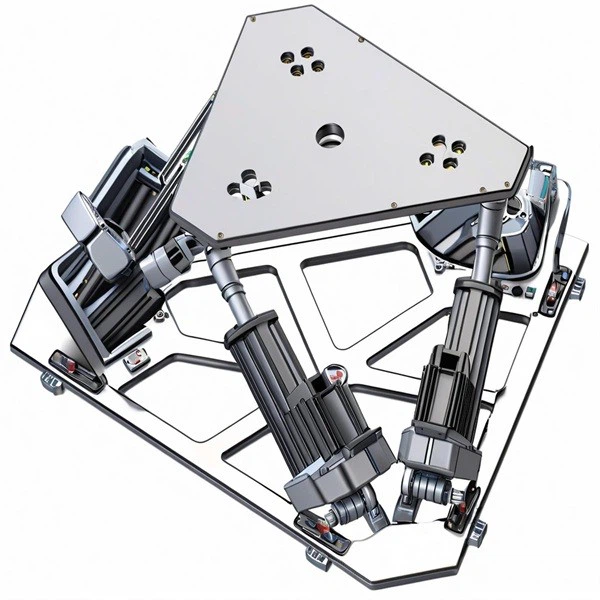
Let's first understand what a 6 DOF rotational platform is. It's a pretty cool piece of tech that can move in six different ways: three translations (along the X, Y, and Z axes) and three rotations (pitch, roll, and yaw). These platforms are used in all sorts of industries, like aerospace, automotive, and robotics, for testing, simulation, and research purposes.
Now, let's dig into the electromagnetic interference. EMI is basically the disruption that occurs when an electromagnetic field affects an electrical circuit. In the case of a 6 DOF rotational platform, there are several sources of EMI.
One major source is the motors. The 6 DOF platform typically uses electric motors to drive its movements. These motors, especially when they are starting up, stopping, or changing speed, can generate a lot of electromagnetic noise. When the motor's current changes rapidly, it creates a changing magnetic field, which in turn can induce unwanted currents in nearby circuits. For example, if there are sensors on the platform to measure its position or orientation, these sensors can be affected by the motor - generated EMI.
Another source is the power supply. The power supply unit that provides electricity to the platform can also be a culprit. Switch - mode power supplies, which are commonly used because of their efficiency, can generate high - frequency noise. This noise can spread through the power lines and affect other components on the platform.
The control system of the 6 DOF platform is also vulnerable to EMI. The control board, which sends signals to the motors to control their movements, has sensitive electronic components. Any external electromagnetic field can interfere with the signals on the control board, leading to inaccurate movements of the platform.

So, what are the characteristics of this EMI?
Frequency Spectrum
The EMI generated by a 6 DOF rotational platform has a wide frequency spectrum. The low - frequency part, usually below 1 MHz, can be caused by the mechanical vibrations of the motors and the power supply ripple. For example, the mechanical vibrations of the motor can cause a slow - changing magnetic field, which results in low - frequency EMI.
The high - frequency part, above 1 MHz, is mainly due to the fast - switching actions in the power supply and the electronic control circuits. When the transistors in the power supply or the control board switch on and off quickly, they generate high - frequency electromagnetic waves.
Amplitude
The amplitude of the EMI can vary depending on the operating conditions of the platform. When the platform is running at high speed or under heavy load, the amplitude of the EMI is usually higher. For instance, if the platform is performing a rapid rotation or a large - scale translation, the motors need to draw more current, and the power supply has to work harder. This increased activity leads to a stronger electromagnetic field and thus a higher amplitude of EMI.
Directionality
The EMI also has a certain directionality. The magnetic field generated by the motors is usually strongest in the vicinity of the motors themselves. So, components that are close to the motors are more likely to be affected. Also, the power lines can act as antennas, radiating the EMI in a particular direction. If the power lines are not properly shielded, the EMI can spread along the length of the lines and affect other parts of the platform or even nearby equipment.
Mitigation of EMI
To deal with the EMI issues, there are several techniques that we, as a 6 DOF rotational platform supplier, use.
We use shielding. For the motors, we can enclose them in a metal casing. The metal casing acts as a Faraday cage, which blocks the electromagnetic field from escaping. Similarly, the control board can be shielded to protect it from external EMI.
Filtering is another important technique. We can install filters on the power lines to remove the high - frequency noise. For example, a low - pass filter can be used to allow only the low - frequency components of the power signal to pass through, while blocking the high - frequency noise.
Proper grounding is also crucial. By connecting all the components of the platform to a common ground, we can provide a path for the unwanted currents to flow safely away. This helps to reduce the potential difference between different parts of the platform and minimizes the effects of EMI.
Now, if you're in the market for a 6 DOF rotational platform, you might also be interested in some related products. Check out our Vibration Test Table, 3 Axis Motion Platform, and 3 DOF Motion Platform. These products also have their own unique features and can be useful in different applications.
If you think a 6 DOF rotational platform is what you need for your project, don't hesitate to reach out for a purchase negotiation. We can discuss your specific requirements, the EMI mitigation techniques we can apply, and the overall performance of the platform. We're here to help you get the best solution for your needs.
References
- "Electromagnetic Compatibility Engineering" by Henry W. Ott
- "Handbook of Electromagnetic Compatibility" edited by Clayton R. Paul